Punta Cana with Food Allergies: Gluten-Free Travel Guide (2026)
Last updated:
A buffet label is only the beginning. Here is how to discuss ingredients, preparation and island lunches before committing to your Punta Cana holiday plans.
Can you plan Punta Cana with food allergies or coeliac disease?
You can investigate a Punta Cana holiday around your food requirements, but the useful answer comes from the kitchens and providers you will actually use. A resort advertising international cuisine, a photograph of grilled fish or an operator saying ‘we have rice’ does not settle whether a particular meal meets your needs. Start the conversation before booking, while you can still choose a different property, outing or meal arrangement.
Coeliac disease is an immune condition triggered by gluten, including gluten in wheat, barley and rye; it is different from a wheat allergy. Other food allergies require avoiding the specific food concerned. Tell the kitchen which condition and ingredients apply to you, using the instructions agreed with your clinician. Our guide to meals without meat or animal products covers a different planning question; neither a vegan label nor a vegetarian option confirms suitability for an allergy.
Before booking a resort: ask who will prepare your meals
Send your dates, party size and exact requirements to the property and ask for a response from the chef or food-and-beverage team. Separate breakfast, the main buffet, reserved restaurants and food served away from the main kitchen. Ask whether a named person can discuss a specific meal, what notice is needed and how the arrangement reaches the staff on the day. A general ‘special diets available’ reply needs a more detailed follow-up.
Request written confirmation of what they can and cannot accommodate, rather than a promise that everything will be fine. Reconfirm on arrival and whenever the restaurant or shift changes. If an answer remains unclear, retain the flexibility to eat elsewhere or change the plan. We do not rank resorts as allergy-safe: kitchen practices and the needs of individual guests cannot be established from a star rating or an old review.
Buffets and shared equipment: the questions behind the menu
Ingredients and handling are separate checks. Ask about shared fryers, grills, toasters, chopping boards, serving utensils and preparation surfaces. Cross-contact means an unwanted food protein reaches another food; removing a topping or cooking a dish again is not a reliable way to resolve that problem. At a buffet, ask whether a suitable plate can be prepared and handed over by the kitchen instead of assuming the shared display is appropriate.
Useful questions are concrete: Which oil and pan will you use? Has the sauce been checked? Can you use cleaned equipment and prevent contact with my excluded ingredient? Who will identify my plate? A clean-looking counter and fresh tongs alone are not a complete handling plan. If staff cannot explain the process, do not turn uncertainty into an agreement simply because the dining room is busy.
Dominican dishes: start with ingredients, not a safe-food list
Rice, beans, plantains, cassava, vegetables and grilled meat can be starting points for a kitchen conversation. The finished dish still depends on the recipe, seasonings, stock, sauces and equipment. Fried fish may have a coating; plantains may share frying oil; a rice dish may use a seasoning mix you have not checked. Ask about the actual preparation being served, not what a familiar dish usually contains at home. A plate of mangú may arrive with cheese, egg and salami, while casabe is a cassava-based bread. Neither name is a guarantee about the complete plate or its preparation.
Our introduction to local dishes and ingredients helps you recognise menu names. For an allergy, name the exact food rather than requesting a vague ‘special diet’: milk, egg, fish, shellfish, peanuts and particular tree nuts are not interchangeable. For gluten-free shopping, read the full current package and any relevant precautionary statement; do not assume an imported brand has the same formulation or labelling as the version you buy at home.
For the practical shopping trip, our supermarket and grocery-shopping guide compares branch locations, first-night provisions, checkout, return transport and the questions to settle before arranging delivery.
Saona and Catalina: settle the island lunch before the transfer
The four-stop island itinerary includes lunch at Mano Juan, while the reef-and-beach outing also advertises an included Dominican buffet. Those inclusions describe the standard products. They are not confirmation of a gluten-free or allergy-appropriate meal, dedicated utensils or a separate preparation area. Send your requirements before paying and ask who provides the lunch, what specific meal is proposed and how it will reach you.
Confirm what happens if the agreed meal cannot be supplied. Ask whether you may bring a suitable backup and how it can be carried or stored; permission and refrigeration are not automatic. A boat day also changes the logistics of returning to shore. Discuss whether that itinerary fits your personal emergency plan with your clinician, rather than treating a private booking or smaller group as a medical safeguard. We can check the proposed arrangements; we cannot certify a kitchen from an itinerary.
Restaurants, apartments and a private chef
For an independent restaurant, contact the kitchen before choosing a table and repeat the request with the staff serving you. Ask about a specific dish and its preparation; an online gluten-free filter or another traveller's successful visit is not confirmation for your meal. Keep the written exchange available, but expect to reconfirm ingredients and handling when you order.
An apartment can offer more control over shopping and cooking, provided you check its equipment and preparation space. If you are considering a cook for your villa, explain your requirements before agreeing a menu or price. Ask about ingredient sourcing, shared equipment and what the chef can realistically accommodate. Paying for a private service does not itself establish an allergen-free kitchen. A provider saying they cannot meet a requirement is useful information, not a reason to negotiate away that requirement.
Spanish messages to show the kitchen
For an allergy, adapt this message to the exact food and your clinician's advice: ‘Tengo alergia a [alimento]. Necesito evitar ese ingrediente y el contacto cruzado durante la preparación y el servicio. ¿Puede confirmarlo la persona responsable de la cocina?’ It asks the responsible kitchen to confirm avoidance of the ingredient and cross-contact during preparation and service. Add your own severity and emergency information accurately; this template is not a complete personal medical card.
For coeliac disease: ‘Tengo enfermedad celíaca. Necesito comida sin gluten y evitar el contacto cruzado con trigo, cebada y centeno. ¿Pueden revisar los ingredientes y la preparación conmigo?’ That says you have coeliac disease and asks to review ingredients and preparation. Use a translated card checked for your individual requirements, keep a copy offline and do not rely solely on an app translating ‘no flour’. Wheat, milk and shellfish are trigo, leche and mariscos; name the particular allergen rather than assuming a broad category is understood.
Children, supplies and your personal preparation plan
For a child, make sure the adults supervising meals know the agreed arrangements, including snacks, kids' clubs and food offered during outings. Ask who can discuss ingredients with you; a colourful children's buffet is not a separate dietary protocol. Carry a practical food backup where permitted, and check transport, storage and entry rules before bringing food across a border or onto an activity.
Before travel, follow your clinician's advice on your personal action plan and prescribed supplies. Keep essential items accessible during transport and excursions, rather than in a hotel room or an inaccessible checked bag. Confirm emergency contacts and access to care for your actual location; do not assume a remote island stop has the same facilities as your resort. Our health and pharmacy planning guide provides wider destination context, not an individual treatment plan.
The message to send before you book
Send the date, hotel, number of travellers, exact excluded ingredients and the handling requirements you have been advised to follow. Then ask: What meal can the actual kitchen provide? Who has confirmed it? How will the plate be identified? What happens if the arrangement changes? Include a request to discuss any permitted backup. Keep the response and reconfirm before departure; do not wait until a shared transfer is already at the lobby.
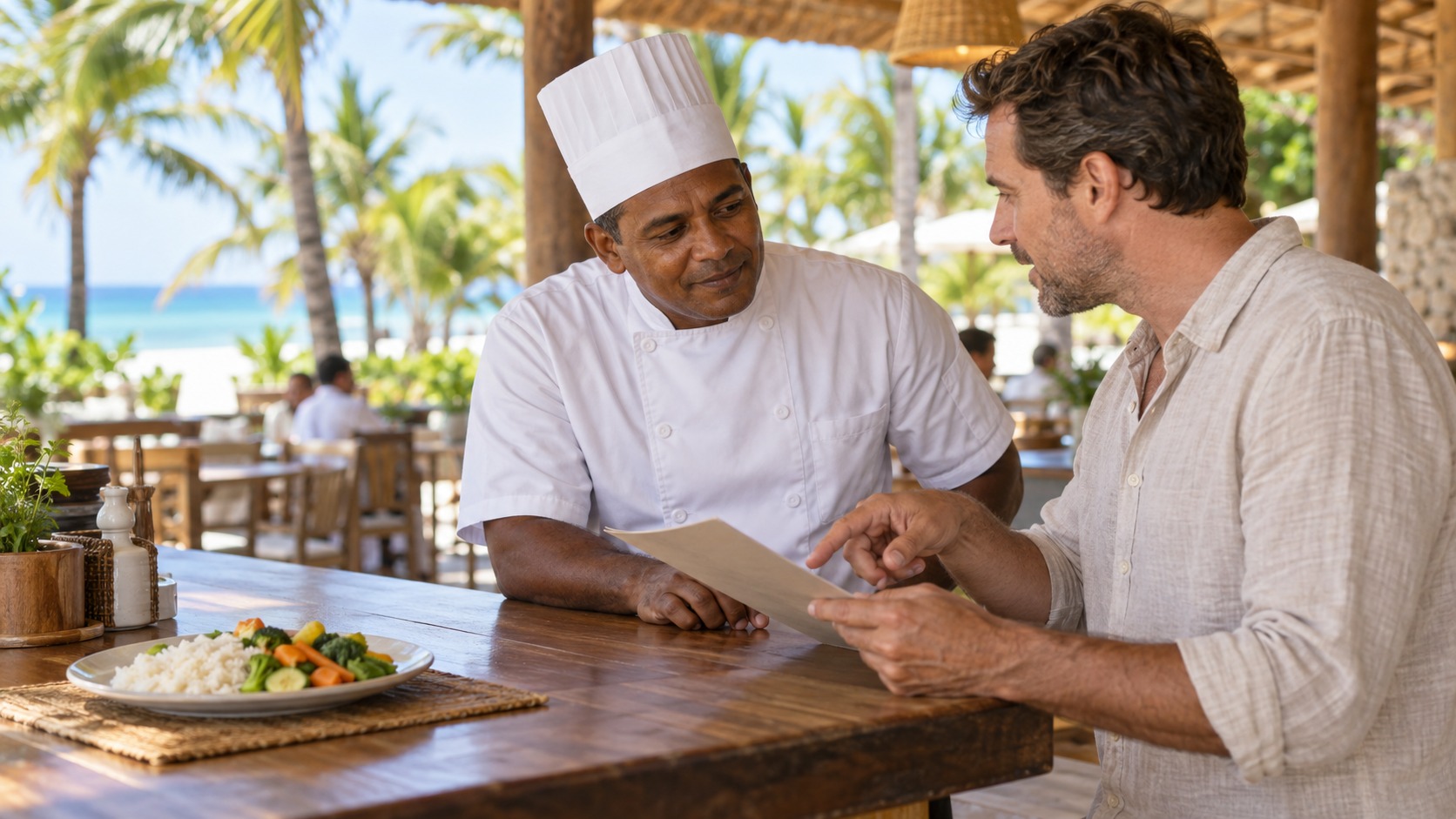
For a Cana.Tours outing, use the existing WhatsApp button to discuss the specific meal arrangements before booking. We will distinguish what has been checked from what still needs the provider's answer. Research checked on 27 October 2026 included CDC Yellow Book 2026, NIDDK, NHS and FARE guidance. This is a travel-planning guide, not a clinical assessment or certification of any venue. The cover is an AI illustration of a kitchen conversation, not a photograph of a named restaurant or a verified suitable meal.
Ask the specific property about your condition, ingredients and preparation. A gluten-free menu item or buffet label does not confirm separate handling for coeliac requirements. Obtain a kitchen-level answer before booking and reconfirm on arrival.