Taíno Heritage from Punta Cana: History, Caves & Cultural Shows
Last updated:
A cave painting, an archaeological collection and a staged evening show tell different stories. Here is how to understand the Taíno connection and choose the cultural day you actually want.
Taíno culture in Punta Cana: what can you actually experience?
You can use a Punta Cana holiday to learn about the Indigenous history of Hispaniola, but start by choosing the kind of experience you want. Looking at rock art, studying a labelled museum object and watching a Taíno-themed performance are not interchangeable. A place with a Taíno name is not automatically an archaeological site, and a cultural show is not proof of an unchanged ancient ceremony.
Our approach is to separate evidence, interpretation and entertainment. That makes the choice more interesting, not less: you can enjoy a show while knowing what it is, or give a museum the quiet time it deserves. For greetings, everyday etiquette and useful phrases rather than archaeology, read our guide to Dominican customs and useful Spanish.
Who were the Taíno—and why is “they disappeared” incomplete?
Taíno is used for Indigenous peoples of the Greater Antilles and neighbouring islands, including Hispaniola, the island now shared by the Dominican Republic and Haiti. It does not mean that every Caribbean Indigenous group had one language, one political system or an identical way of life. Before European colonisation, island societies had their own communities, farming, craftsmanship, leadership and spiritual traditions.
European conquest brought disease, enslavement, violence and profound disruption. That history should not become a cheerful footnote to a holiday show. Equally, saying that Indigenous people simply vanished erases survival and present-day identity. People in the Dominican Republic and elsewhere in the Caribbean continue to recognise and reclaim Taíno ancestry and heritage. An attraction's performers should not be assumed to represent every such community.
What survives: food, language and objects with a context
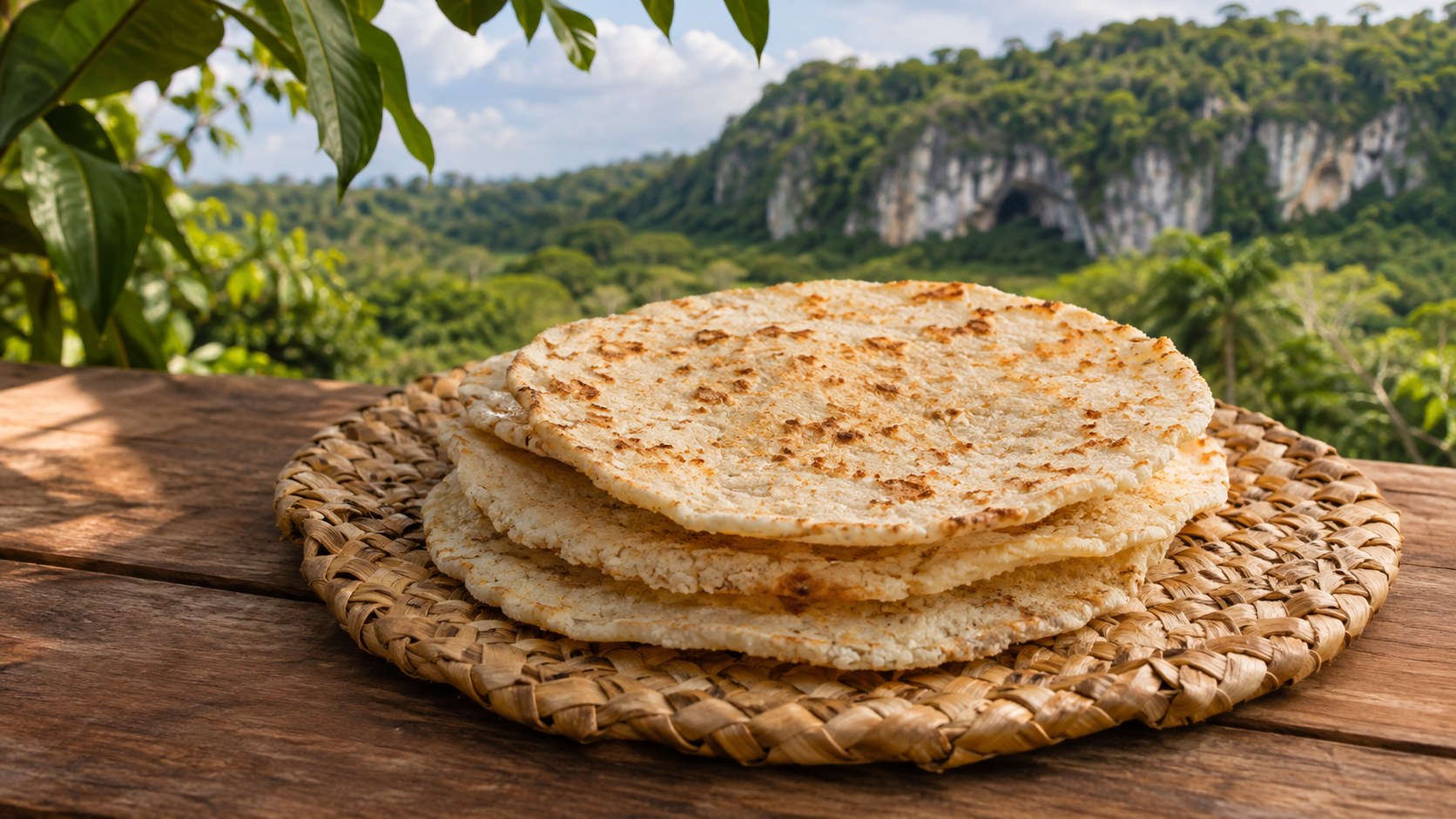
Casabe, a cassava flatbread, offers an approachable connection with the region's Indigenous food heritage. It is still made and eaten, not just reconstructed for visitors. Ask about ingredients and preparation if it appears on a menu; a tasting does not by itself establish that you have visited a historic Taíno settlement. Today's Dominican food also reflects African, European and other influences, so avoid describing a whole modern buffet as ancient Taíno cuisine.
Words such as canoa and hamaca are another reminder of Indigenous Caribbean influence in Spanish. In a collection you may see the term cemí or zemí, associated with spiritual power, ancestors and sacred representations. It deserves more explanation than a souvenir label saying “good luck”. Read the object's provenance and interpretation. A repeated face or spiral is not a universal dictionary: do not assign every rock image a confident meaning without evidence.
Cave art and the museum at Altos de Chavón: choose your approach
For rock art in its setting, compare our visitor guide to Cueva de las Maravillas. Pictographs are painted images; petroglyphs are worked into rock. They are not the same technique. Ask what the permitted visitor route actually includes and which language the guide uses. The cave is a separate road trip from Punta Cana, not an attraction inside a Bávaro resort. An underground swimming stop in an adventure park is not an equivalent visit.
For objects and interpretation, consider the guide to the regional archaeological museum. The museum and the modern Mediterranean-style village around it are different things; the village is not an excavated Taíno settlement. Check museum opening arrangements separately from general visitor access. Our Los Haitises planning guide describes a different nature-and-cave outing. Confirm named cave stops and current access rather than assuming every park boat trip visits the same artwork.
Taíno-themed shows: enjoy the programme without confusing it with archaeology
A staged cultural presentation can be part of an enjoyable adventure evening. It is also a modern visitor production, with choices made for an audience. Costumes, music and narration do not by themselves prove that every element reproduces a documented historical practice. Ask what is being interpreted, who developed the explanation and whether questions are possible. Do not treat a performer as a museum exhibit or assume their ancestry from their costume.
Our practical guide to the night buggy, cave and show experience explains the mixture of activities. Choose it because that whole evening appeals to you. If your priority is sustained historical interpretation or looking closely at objects, a guided museum visit may be a better fit. Dominican carnival, product tastings and a Taíno-themed segment can share a programme without all having the same historical origin.
Choose one cultural priority before building the day
For a first introduction, decide whether you most want to see rock art, understand a collection or enjoy an organised activity evening. Then plan around that priority. A family can prepare one question—how an object was used, how an image was made, or how people grew food—instead of trying to remember a list of dates. Match the outing to attention span, walking conditions, boat boarding and comfort underground.
For any visit beyond the resort area, request the complete hotel-to-hotel plan: both drives, guiding language, admission, waiting, walking and any meal. Two nearby-looking map pins do not establish a workable combined itinerary. With Los Haitises, ask about the boat and cave sections as well as road travel. With a museum, verify that its own timetable fits the day. We do not promise universal journey times, guaranteed cave access or a community encounter that is not explicitly arranged.
Visit and shop with respect
Do not touch, trace, wet or rub rock art, or make your own mark beside it. Stay on the permitted route and follow the site's photography rules; visitor lighting is not permission to use flash. Leave pottery fragments, stones and anything that might be an archaeological object where they are. Tell the guide if something needs attention rather than moving it for a better photograph.
For a souvenir, ask who made it, what material it uses and whether it is a modern piece. A contemporary interpretation can be worth buying without being passed off as an original. Avoid anything sold as an excavated artefact, and do not buy on the strength of a promised sacred power. Ask permission before photographing people and accept a refusal. Respect does not require pretending to understand a symbol: a careful question is more useful than an invented explanation.
The questions to send before booking
Send your accommodation, date, group size and ages, then state the priority: “We want a visit focused on Taíno history, with interpretation in [language]. Please name the site, confirm admission and guide arrangements, explain the walking or boat sections and give the expected return.” Ask whether the quoted itinerary includes a museum, a cave or a performance. These words should describe actual stops, not a general promise of culture.
If the adventure evening is the right choice, check the current night-tour programme and booking options. That page is for the advertised experience, not a scheduled departure to every museum or archaeological site discussed here. Keep the existing WhatsApp enquiry for questions about the specific programme. Cover image: AI-generated editorial still life of cassava bread, not a photograph of a historic settlement, museum collection or particular attraction.
Yes. Choose between a visit focused on rock art, a museum collection or a Taíno-themed performance. Confirm the actual location, journey and guiding language; not every option is in Punta Cana itself.